
Land, the Wealth We Can Actually Tax
California's land, the proposed Billionaire Wealth Tax, and a better way to fund the state's future
Overview
Land, the wealth we can actually tax
California is trying to fill a gaping revenue gap created by cuts to federal funding with a Billionaire Wealth Tax (BWT): a 5% one-time levy on roughly 200 California billionaires, structured to raise $100 billion over five years. Unfortunately, the BWT is critically flawed and unable to solve this problem. There is, however, a viable alternative that can sustainably fund California for years to come: a Land Value Tax (LVT).
We take no position here on whether California should increase or decrease the total amount it collects in taxes. However, as long as California is committed to reforming the tax code anyway, we strongly suggest employing land value tax instead of wealth, income, or capital taxes. Land value taxes are harder to avoid and directly align California’s revenue base with the value it itself creates for its residents.
The case for trading the BWT for an LVT rests on three facts:
- 1Land cannot move; capital can. The BWT applies only to taxpayers who were California residents on its retroactive cutoff date of January 1, 2026. However, six California billionaires holding roughly $540 billion in combined wealth had already moved their tax residency out of state before that date. A seventh, Mark Zuckerberg (worth approximately $220 billion), moved in early 2026, and will likely challenge the retroactive provision should it become law. Additionally, the BWT’s proponents included an erroneous $200 billion overestimate in the proposal’s revenue projections. The end result is the loss of nearly half the BWT’s assumed $2 trillion tax base before the measure has even been put before voters.
- 2LVT is more pragmatic and feasible than the BWT. A Land Value Tax can be administered through California’s existing property tax infrastructure. Although Prop 13 has weakened that infrastructure’s market-value calibration, the work needed to update it is well-understood, legally uncontroversial, and already practiced in many other states. A wealth tax, by contrast, requires building a novel administrative apparatus to value private equity, founder shares, and other illiquid holdings, while simultaneously defending four highly controversial provisions (taxing intangible wealth, taxing control-weighted valuations, retroactive reach to January 2026, and worldwide-net-worth scope) against legal challenges from not only billionaires, but also other states and possibly other countries. Even if the measure survives, any one of those challenges could delay collection by years.
- 3California has $8.14 trillion in land but only about $1 trillion in still-taxable billionaire wealth. The land tax base is roughly eight times larger than what remains of the billionaire tax base, appreciates with the broader California economy, and cannot move out of state. A 0.2% LVT raises the same $20 billion per year that the BWT promises, and a 0.86% LVT would cover the entire $87 billion California Health & Human Services budget.
California's land value dwarfs billionaire wealth — and can't move
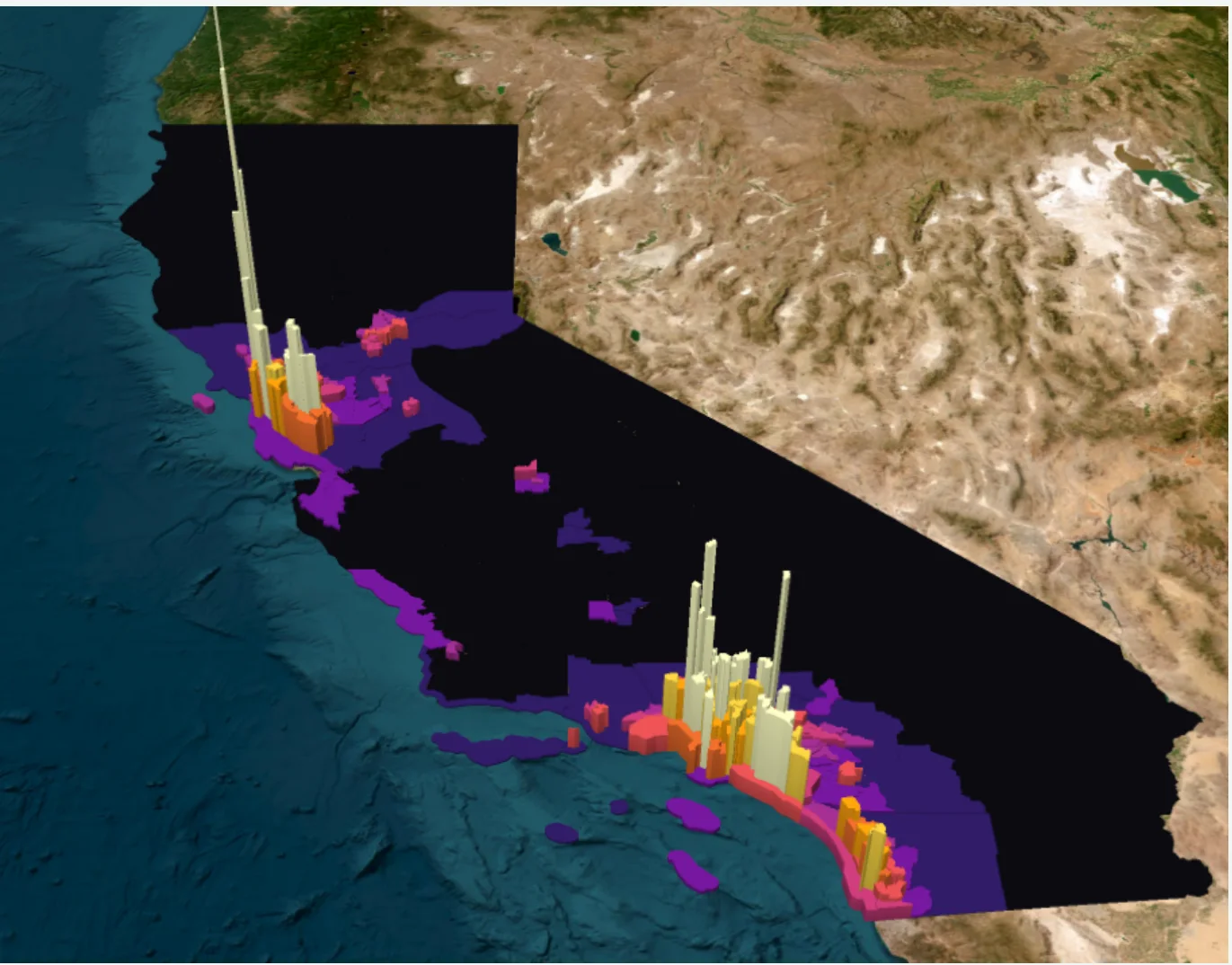
The bulk of that land value is highly concentrated in wealthy coastal cities.
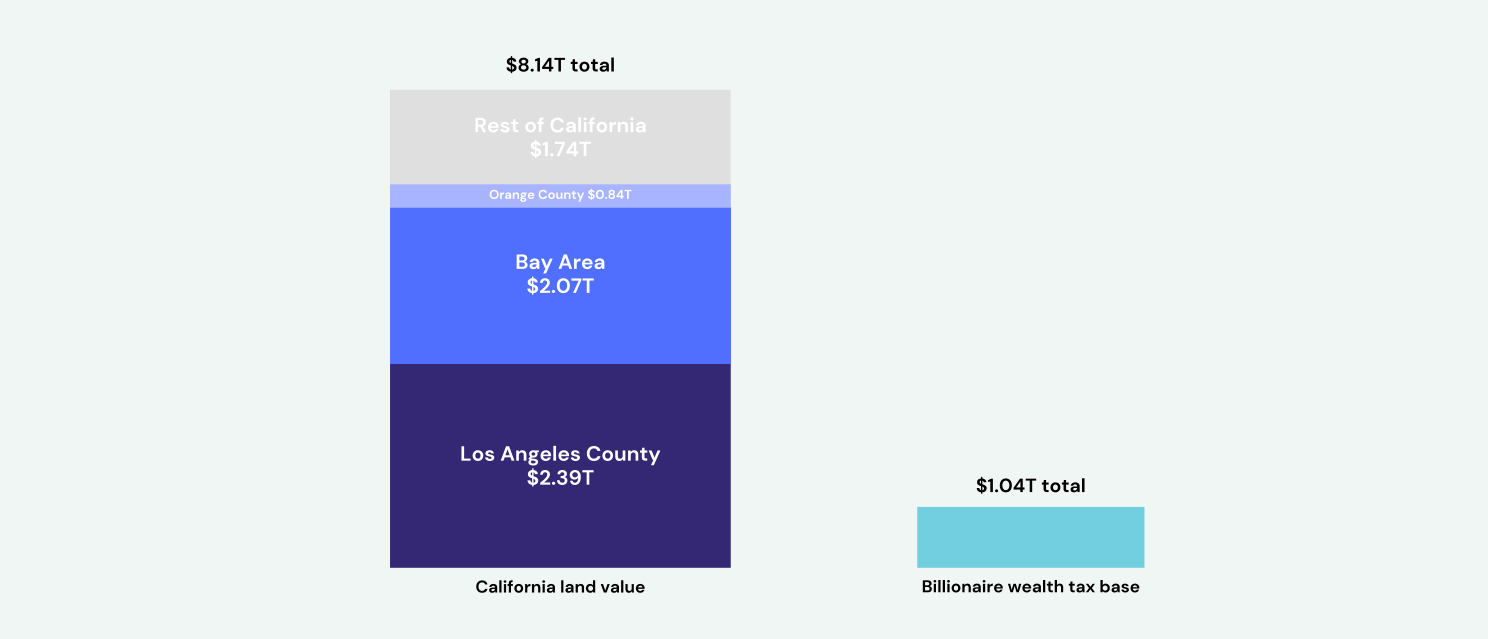

Source: CLE estimation of land value from Regrid, FHFA, and USDA data; CLE estimation of wealth from Jaros, Rauh, et al., Galle, Gamage, Saez and Shanske
In support of this, this report introduces an original parcel-level estimate of California’s total land value, triangulated across three independent estimation methods: recent transactions, FHFA rates, and time-trended historical sales. All three converge on the same range. With those numbers in hand, we can confidently answer the question, “what tax rate on California land would raise $20 billion dollars?”
California's Billionaire Wealth Tax
California's healthcare budget has a $19 billion annual hole, opened by federal funding cuts under the One Big Beautiful Bill Act.
The state’s existing tax instruments, already high and bearing most of the progressive load, cannot easily produce more. Therefore, the legislature has reached for the most extreme version of a progressive tax: a 5% one-time levy on roughly 200 California billionaires, payable over five years, expected to raise $100 billion total ($20 billion per year). The expert report supporting the measure, by Galle, Gamage, Saez, and Shanske (henceforth GGSS), assumes a $2 trillion taxable base and a 1% annual rate.
The tax targets intangible assets such as stocks, bonds, and even “founding shares” in companies, whether or not the assets themselves are physically located in California. Notably, all land and real estate are specifically exempted.
We evaluate the BWT against four stated goals; we find that the BWT fails three of them outright, and accomplishes one of them only ironically.
Goal 1: Reduce billionaire wealth in California
Judged purely on the goal of reducing the amount of billionaire-owned wealth located in California, the BWT has already been a smashing success without even becoming law. GGSS’ estimate for a $2 trillion billionaire tax base was outsourced to Forbes’ real-time California billionaire list as of January 1, 2026, which counts 213 California billionaires. Unfortunately, in relying entirely on the Forbes list, GGSS make certain errors and doubtful assumptions.
A paper by Jaros, Rauh et. al, asserts that the wealth of six individuals were included in GGSS’ estimates (Larry Page, Sergey Brin, Peter Thiel, Don Hankey, Travis Kalanick, and Steven Spielberg, with combined wealth of roughly $540 billion) who had already moved their tax residency out of California prior to that date. A seventh, Mark Zuckerberg, holding approximately $220 billion, moved his residency in early 2026.
The reasons given for these moves vary by individual. Uber co-founder Travis Kalanick relocated from San Francisco to Austin on December 18, 2025, fourteen days before the BWT’s retroactive cutoff, and when asked about the timing remarked, “I don’t know what’s so specific about Dec. 18, but let’s just say it’s prior to January.” Don Hankey, the “king of subprime car loans,” told Forbes the proposal was “ridiculous” and that he “felt a little bit like I wasn’t wanted.” Google co-founder Sergey Brin spent $57 million opposing the ballot measure and likened California to the “Soviet Union.” Steven Spielberg’s representative, by contrast, told the LA Times the move was a long-planned family decision driven by a “desire to be closer to their New York based children and grandchildren.” As for Peter Thiel, his relocation began in 2018, many years before the current BWT proposal was drafted.
For the BWT’s revenue arithmetic, however, motivation matters less than mechanics because the proposed tax applies only to taxpayers who were California residents on that same date, and each of these individuals has a documented out-of-state move and a defensible claim of non-residency under California’s “closest connection” residency test. GGSS argue that the Franchise Tax Board will determine the movers are still California residents and tax them anyway, but that determination will likely be litigated and appealed for years. Whatever the eventual outcome of that residency litigation, the wealth these individuals took with them is unlikely to reach the state’s coffers in time to address the funding shortfall the BWT is meant to solve.
Percent of billionaire wealth that has recently left California
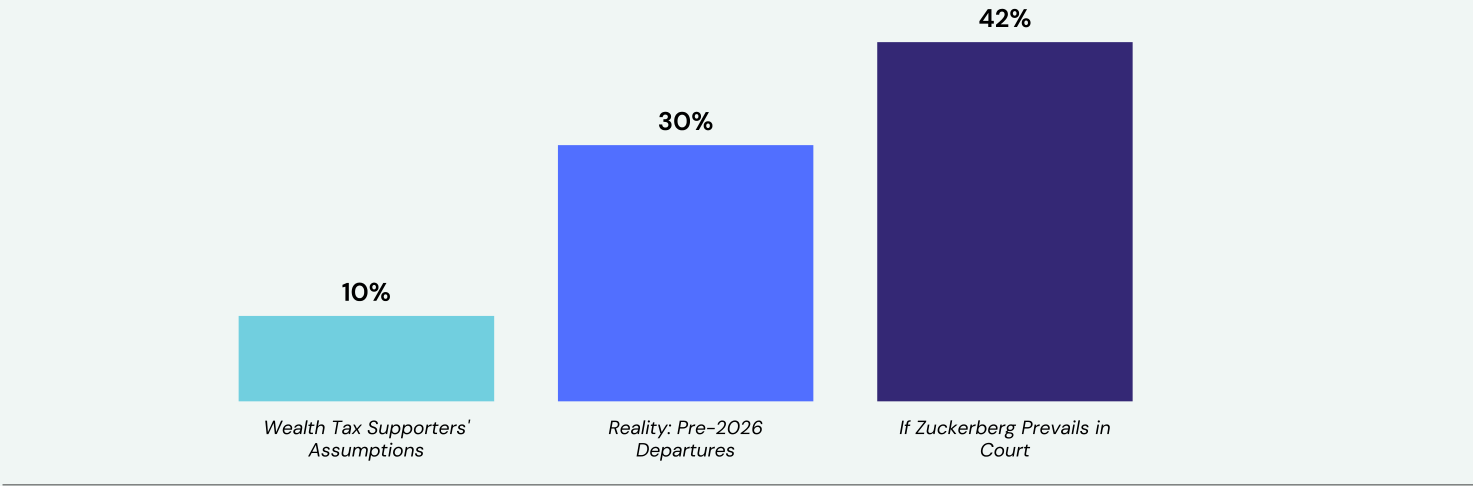
Source: CLE analysis of Jaros et al (2026), Forbes & Bloomberg
Goal 2: Cover a one-time budgetary shortfall
The GGSS analysis projects $20 billion per year in revenue at a 1% annual rate against the $2 trillion taxable base built from Forbes’ California billionaire list. The math depends on that base actually being available at collection time. Three forces significantly erode that tax base and call into question how much the BWT can actually raise.
First, Jaros, Rauh, et al’s analysis also identifies a $200 billion overestimation in the GGSS calculation, not due to residency, but to simple misclassification of certain assets.
Second, the aforementioned pre-2026 billionaire departures cleared the proposal’s January 1, 2026 retroactive cutoff. Their roughly $540 billion of wealth was counted in the GGSS base but will be fiercely contested in court.
Third, Mark Zuckerberg moved his tax residency out of California in early 2026, after the BWT’s January 1, 2026 retroactive cutoff date. The bill’s framers plan to capture a share of his $220 billion by enforcing the retroactive provision, but Zuckerberg can be expected to file suit challenging that provision on the grounds that it cannot lawfully reach a taxpayer who had already established residency in another state prior to the bill becoming law.
Combined, these three forces remove approximately $0.95 trillion from the assumed $2 trillion base, a 47% reduction before implementation has even begun.
If the rate stays at the proposed 1%, the revenue projection will collapse with the base. To raise the targeted $20 billion per year against a half-eroded base, the rate would need to nearly double, to about 1.6% in our realistic scenario or 1.9% if Zuckerberg also escapes. The BWT proposal as written does not account for this adjustment. In our realistic scenario (accounting for the pre-2026 departures and the Jaros-Rauh recalculation but not the Zuckerberg outcome), California would collect $7.4 billion less per year than projected. In our pessimistic scenario, where Zuckerberg also avoids the tax, the shortfall reaches $9.6 billion.
California's wealth tax base erodes significantly on billionaire exit
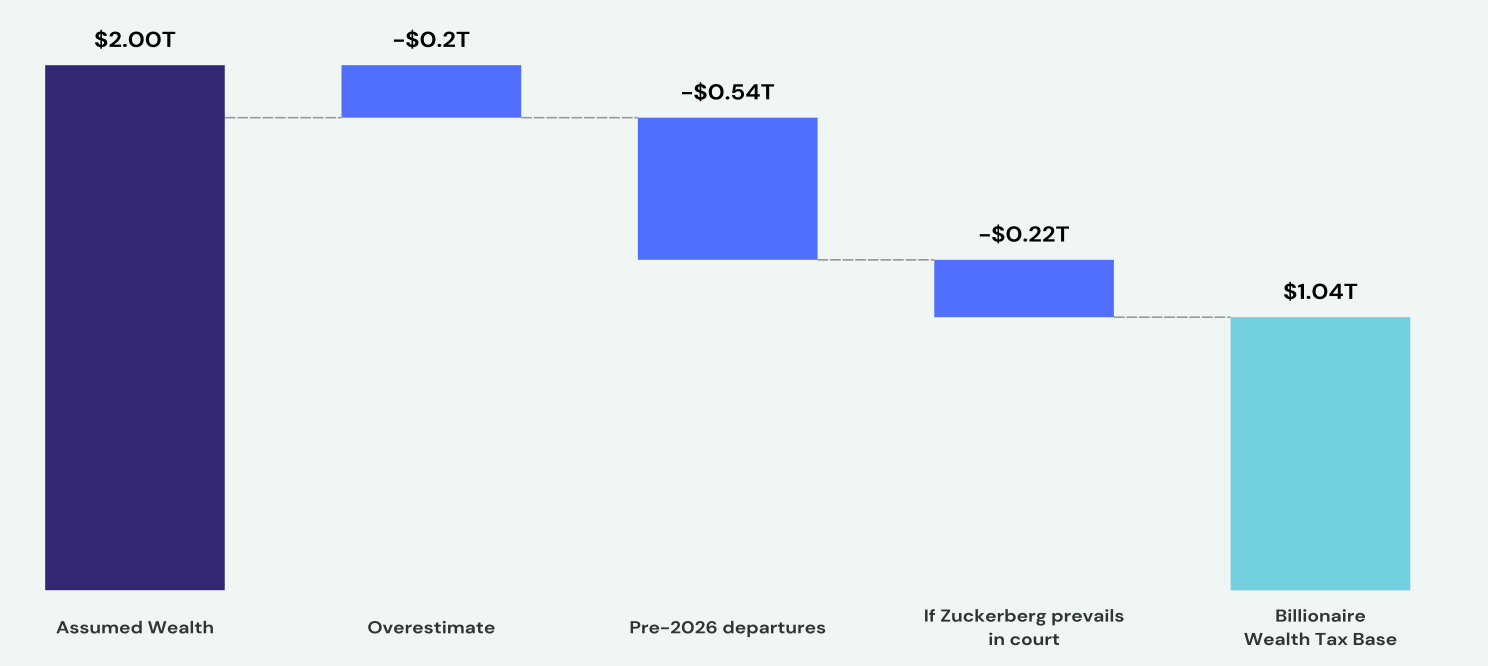
Source: CLE analysis of GGSS (2025), Jaros et al (2026), Forbes & Bloomberg
The BWT as designed will not raise the revenue its sponsors promise, and increasing the rate to compensate for capital flight that has already occurred could stimulate further flight.
Goal 3: Swiftly meet the emergency
Supporters may grant that the BWT falls short of its funding target but argue that the urgency of the healthcare shortfall nevertheless demands immediate action. Unfortunately, the BWT fares poorly on the urgency criterion as well, not because it is a wealth tax, but because of how particularly poorly crafted it is.
The entire purpose of the bill is to address a present crisis caused by the sudden revocation of federal funding, which means that if the measure is held up in court for multiple years, the necessary relief will not arrive in time. The BWT contains not one but four highly controversial provisions, each nearly certain to be contested:
- It establishes new state authority to tax intangible wealth.
- It introduces “control-weighted valuation” for closely-held shares.
- It applies retroactively to January 1, 2026.
- It claims jurisdiction over worldwide net worth, including assets not located in California.
The first three provisions will be challenged by the billionaires themselves, while the fourth invites suits from other states (and possibly other countries) whose residents would be doubly taxed. Any one of these challenges could delay collection by years.
To be fair, any new tax regime, including the land value tax, is certain to face some degree of opposition, which should not by itself be considered disqualifying. The specific problem with the BWT is that it bills itself as both temporary and urgent. A long-term sustainable measure could well be worth a bruising political battle, but a short-term emergency measure becomes moot if it takes too long to implement.
In any case, the BWT has already attracted enough political controversy for California’s own Democratic Governor to turn against it.
Goal 4: Provide for the long term
Even if the BWT succeeds in raising enough money to cover the temporary budget hole caused by federal cuts, it makes no provision for covering that shortfall should the federal cuts become permanent. The implicit hope is that a friendlier presidential administration will soon arrive and restore the lost funding. While it is nice to hope, “hope is not a plan,” as the saying goes, and California should not put its healthcare budget at the mercy of a fickle federal government. Election uncertainty aside, with the national debt soaring to all-time records, California would be wise to hedge against the possibility of continued federal cuts to state funding.
A further complication is raised by the BWT’s stock valuation mechanisms, which many critics contend could threaten California’s tech startup scene by forcing founders who have yet to realize any of their paper wealth to liquidate their holdings and potentially lose control of their companies. Demanding that equities be sold in order to make cash payments arguably undermines the goal of providing for California’s future, because it disrupts the underlying businesses controlled by those shares.
The deeper problem with the long-term framing is that the BWT does not address why California needs the revenue in the first place. The structural shortfall did not arise because federal funding cuts are unique to California, but because California’s existing revenue base is too narrow and too volatile to absorb shocks. A structural revenue problem must be fixed by a structural change to the revenue base.
The next section examines what California’s revenue base actually is, and why it has been broken since 1978.
Why this case study matters beyond this bill
The BWT has California-specific design flaws (the retroactive cutoff, the worldwide-net-worth provision, the control-weighted valuation) that may be fixable in a future draft. But the underlying weakness of any wealth tax is that a tax base consisting entirely of a small group of highly mobile, well-resourced individuals is inherently unstable.
California's tax base has been collapsing for fifty years
The reason California legislatures keep reaching for unconventional revenue tools is that the conventional one, property tax, has been broken since 1978.
California’s Proposition 13 capped property tax growth at 2% per year regardless of market appreciation, set assessed values at 1976 levels, and reset them to sale price only at sale. In a state where home prices have risen approximately 20-fold since 1976, that cap has produced a gap between assessed and market value that grows wider every year.
How big is this gap? It depends on the subject of the gap:
For a parcel that has not changed hands since 1976
For a house unsold since 1976, one can simply compare actual market appreciation since that date (using the CASTHPI index), with linear 2% growth compounded annually. Prop 13 has effectively limited cumulative growth in taxable value to about 2.5x, while actual market values over the same period have grown about 20x. This type of home is now assessed at a mere 12% of the actual price it would fetch. This is the worst case, and applies to the smallest cohort of California homeowners, but it is real nonetheless. These are represented by the solid red line.
For the average California homeowner
The picture depends on which cohort they belong to. The homes of newer buyers reset to market value at purchase and then begin their own slow Prop 13 drift; long-tenured owners are deep into the cumulative gap. Weighting by the U.S. Census figures for the average year each county’s homeowners moved in, we estimate that the effective cohort-weighted statewide assessment for the “average homeowner” sits at approximately 44% of true market value. In other words, most California property is valued for tax purposes at less than half of what it would sell for. The dashed lavender line in the middle of this chart is the cohort-weighted estimate.
For the entire state, parcel by parcel
Our own bottom-up analysis (described in Estimating California’s Land Value, below) finds that total assessed parcel value runs at about 64% of estimated market value, though we can only estimate this figure for the current time, not as a historical time series. This estimate is represented by the yellow line.
The last two methods bracket the true number, with an honest range of 44% to 64%. The headline finding is the same regardless of which method is used: California’s effective property tax base is about half its actual underlying real estate market.
Assessed value as a percent of market value
California, 1976–present
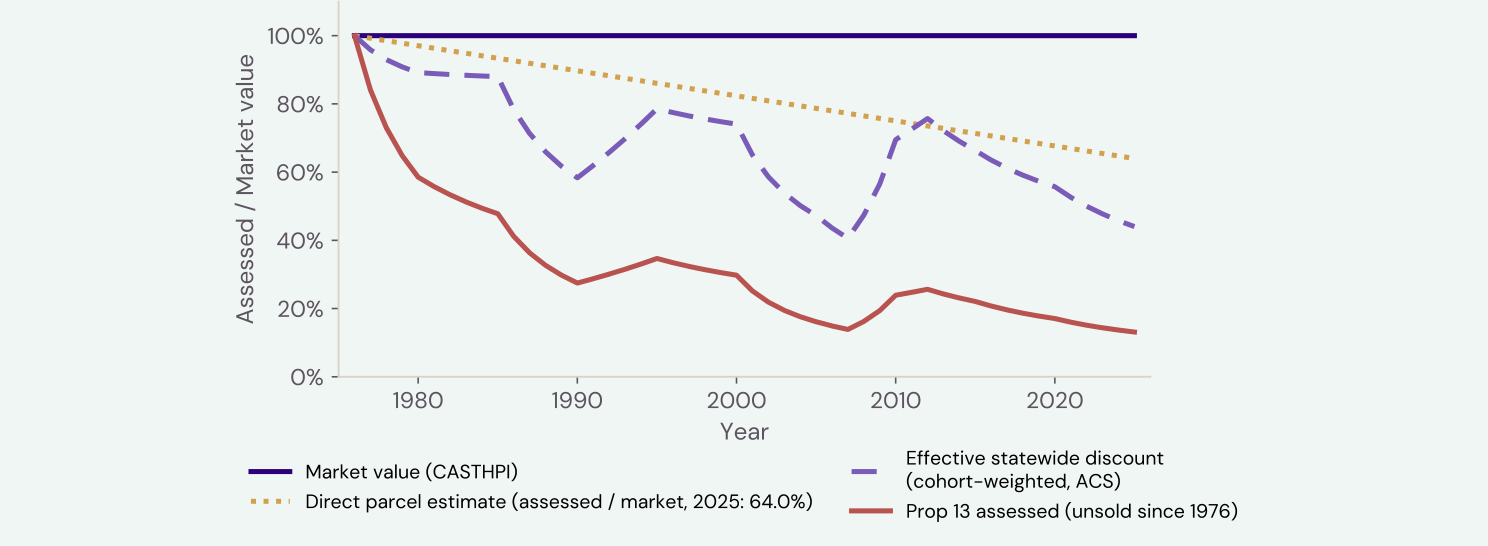
Source: CLE analysis of FRED (CASTHPI & CPIAUCSL), US Census ACS B25038, & CLE parcel pipeline
The first-order consequence: revenue
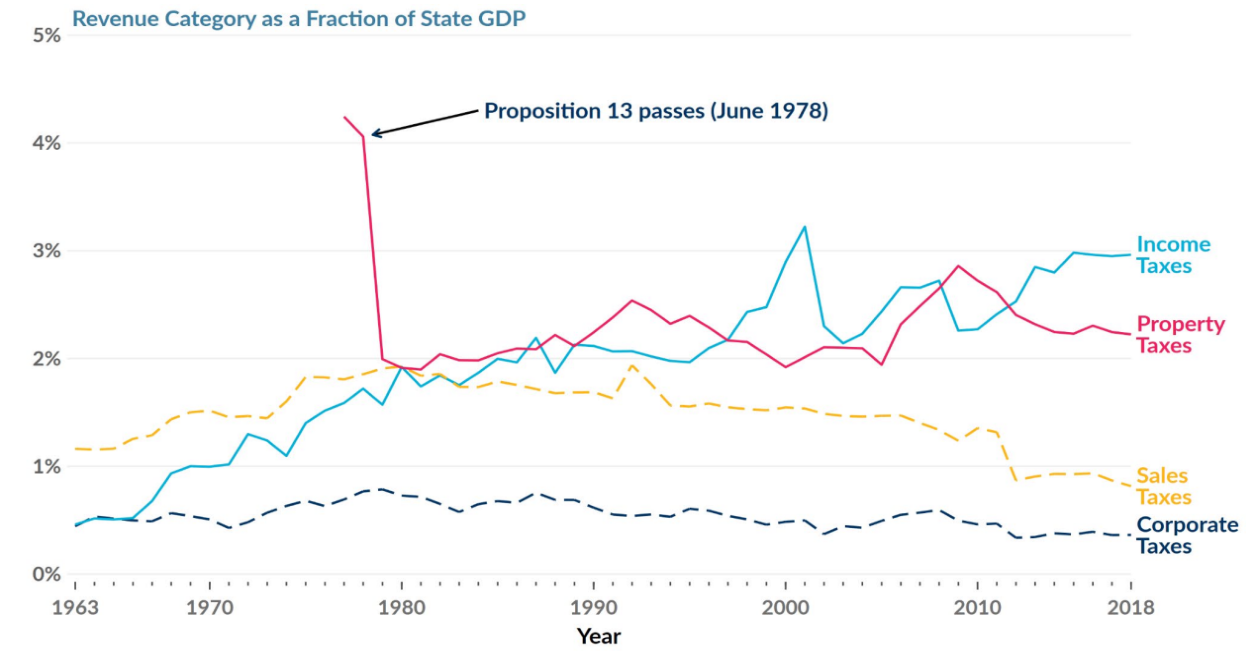
A 2023 parcel-level study by the Berkeley Institute for Young Americans shows that property taxes, which were 4% of state GDP in 1977, dropped to 2% in 1978 and have hovered there since. Income taxes have crept upward to fill the gap, from 1% in 1963 to nearly 3% by 2018.
The composition of California’s revenue has shifted from property, a tax base that does not move, to income, a tax base that does. This structural shift is what creates the conditions for a wealth-tax debate fifty years later: when the most stable revenue base is constrained, every alternative falls on a tax base that can leave.
Source: Berkeley Institute for Young Americans (2023), "A Reexamination of Proposition 13 Using Parcel Level Data." Reproduced unmodified.
The second-order consequence: distortion
The distributional effects of Prop 13 are arguably worse than the revenue effects. Long-tenured homeowners pay tax on 1976 values; their neighbors who bought last year pay on 2024 values. Identical homes carry vastly different tax bills. A young family buying its first house pays an unfair share of the local property tax burden, while the long-established owner two doors down, who benefits from the same schools, parks, transit, and fire protection, pays a fraction.
A 2016 California Legislative Analyst’s Office report describes how Prop 13 creates a punishing penalty for moving, protecting long-established owners while shifting the tax burden onto young families and new buyers (LAO, Common Claims About Proposition 13). The system rewards tenure for its own sake, not productive use. A 1970s-era owner pays a fraction of what a 2025 buyer pays for an identical property next door, and that protected status can pass to heirs.
It is not an exaggeration to say that Prop 13 effectively established a class of landed gentry with hereditary tax privileges.
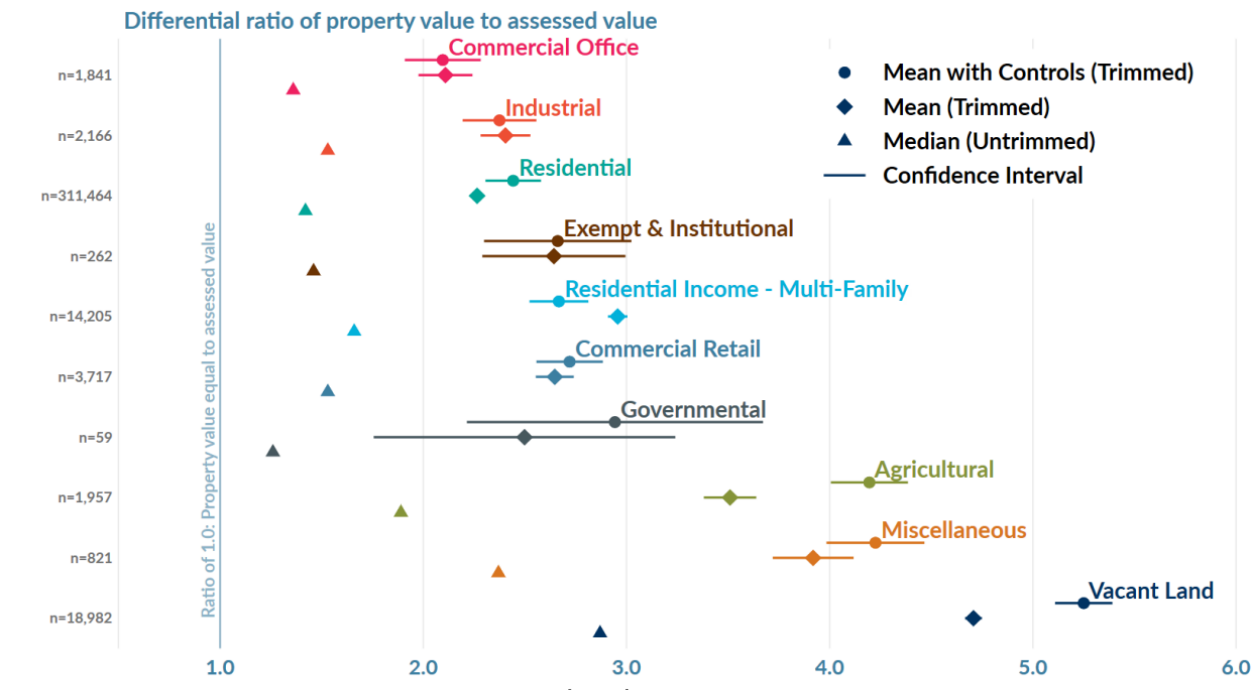
The distortions extend beyond the residential market. Prop 13 also benefits commercial landlords sitting on undertaxed property, and most damagingly, vacant-lot speculators. The study found that vacant land carries the highest relative tax discount of any property class in California, while residential property—the supposed chief beneficiary of Prop 13—enjoys the third lowest.
Source: Berkeley Institute for Young Americans (2023), "A Reexamination of Proposition 13 Using Parcel Level Data." Reproduced unmodified.
When a city builds transit, improves schools, or invests in public safety, the surrounding land becomes more valuable. In a normal property tax system, that public investment generates additional revenue, paying for itself. Under Prop 13, the assessed value cannot keep up. The public funds the infrastructure; private landowners capture the windfall as appreciating land prices and rising rents. The vacant-lot owner, paying pennies on a 1980 assessment, has no pressure to put the land to productive use.
The bridge to the LVT case
California’s tax base is broken because the most natural revenue source, the value of land within state borders, has been frozen at 1970s levels for everyone except the most recent buyers. The state has been short on revenue for fifty years for that reason, not because billionaires have escaped. Adding a wealth tax—and a temporary, one-time one at that—on top of a broken property tax base does not repair it; it creates a parallel, smaller, more mobile base that delivers a fraction of the revenue at much greater political and legal cost. Scarce political capital would be much better spent fixing the property tax base instead.
Furthermore, California should recognize that land is the component of property whose value derives from public investment and locational advantage, and that land cannot move. Therefore, a tax on land, separate from the value of the buildings upon it, captures the public-investment windfall, encourages productive use, and cannot be evaded by departure.
The land value tax
This report does not argue for taxing land instead of wealth, as though the two were opposed. In layman's parlance, land is wealth, one of the oldest and largest forms of wealth in any economy, and the form California has the most of.
This debate simply concerns which kind of wealth California can and should actually tax, and at what rates.
A Land Value Tax is a property tax with one critical refinement: it taxes only the value of land, not the value of buildings or improvements. Two parcels of identical size, shape, zoning, and location would pay the same tax, regardless of whether one holds a single-family home, a vacant lot, or a 20-story apartment building. The tax falls on the land itself, not on what is built on it.
This has several key implications.
A standard property tax punishes development
Build more, pay more. The owner of a vacant downtown lot pays a fraction of what their neighbor with an apartment building pays, even though the vacant lot drags down neighborhood value while the apartment building houses people. Prop 13 amplifies this distortion, because the longer the vacant lot sits, the cheaper its tax becomes relative to its actual market value.
A land value tax is neutral toward what is built
The vacant-lot speculator and the apartment-building owner pay the same tax per parcel. There is no tax penalty for productive use, but there is a holding cost for unproductive use, which causes owners to either build or sell purely from their own self-interest.
A land value tax cannot be passed on to renters
This is one of the few settled questions in tax economics. A standard sales tax flows through to consumers, a corporate income tax flows through partly to workers and partly to consumers, and other taxes have unclear incidence. The land value tax, by contrast, is incident entirely on the landowner, because land supply is fixed. A landlord cannot raise rent in response to an LVT increase, because every other landlord faces the same increase and rent is set by what the market will bear rather than by the landlord’s costs. Empirical studies of LVT-implementing jurisdictions confirm that renters do not bear the burden.
A land value tax captures public-investment windfalls
When a city builds a transit line, the adjacent land becomes more valuable. Under California’s current system, that appreciation accrues entirely to private landowners; the city that funded the investment sees little return. Under an LVT, the appreciation in land value translates directly into additional tax revenue. The community that creates value through public investment captures part of that value back. This is the original Henry George argument, and 150 years later it remains the cleanest description of how an LVT aligns private incentives with public welfare.
A land value tax cannot be evaded by leaving the state
This is the property that makes the LVT particularly suited to California’s current moment. Billionaires can move, their portfolios can move, and their primary residences can be relocated to no-tax states, but the land they leave behind cannot. If a wealthy Californian sells their estate and moves to Texas, the new buyer pays the LVT, and if the estate sits empty, the absent owner pays it. The tax base does not relocate. A conventional property tax functions similarly, because real estate cannot move, but the tax can still be evaded at least in part, because buildings can be demolished, or simply not built in the first place.
These are not radical claims; they are textbook economics. Milton Friedman famously called the LVT “the least bad tax”, and Joseph Stiglitz, on the other end of the political spectrum, has reached the same conclusion in his work on the “Henry George Theorem” (Stiglitz, Pigou, Tiebout, Property Taxation, and the Underprovision of Local Public Goods, 1977). The empirical record from LVT-implementing jurisdictions, including Pittsburgh and other parts of Pennsylvania (Oates and Schwab, The Impact of Urban Land Taxation: The Pittsburgh Experience, 1997), parts of Australia, and Estonia is consistent: the tax raises stable revenue, encourages development, and does not displace renters.
What has been missing for California is not the economic case for an LVT but the empirical one. Without a credible bottom-up calculation of the state’s land-value base, “tax land instead of wealth” remains an abstract proposal.
The next section shows what California’s LVT base actually is, how we measured it, and what tax rate it implies.
Estimating California's land value
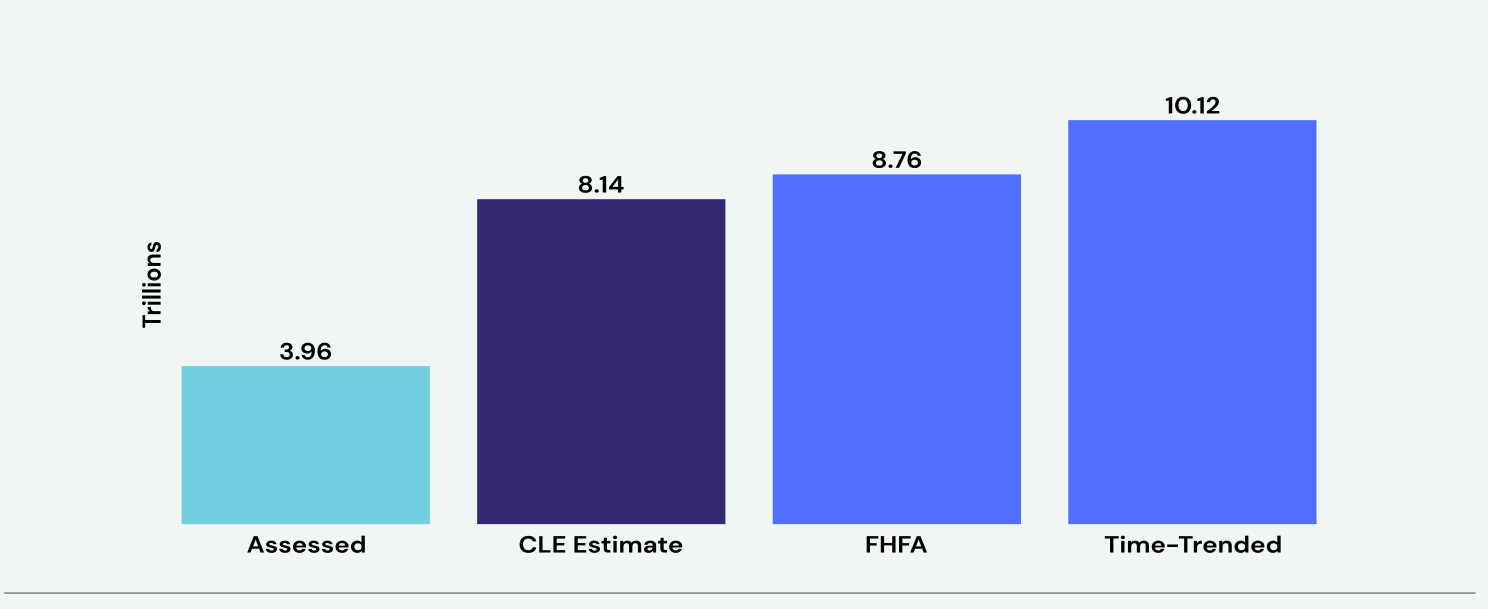
The central empirical contribution of this report is an estimate of California's total land value: $8.14 trillion, sitting at the conservative low end of a range bracketed by federal housing-finance benchmarks at $8.76 trillion and by time-trended sales projections at $10.12 trillion.
This section explains how we arrived at the number, with enough detail to understand the work and trust the result without walking through every parameter.
California-specific challenges
The naive approach would be to download California’s parcel records and simply sum the assessor’s “land value” column. That sum produces a value of $3.96 trillion, which is wrong for two reasons.
Prop 13 freezes assessed values at 1976 levels. Most of California’s assessment roll has not been refreshed in decades. The assessor’s reported land value for a parcel that hasn’t sold since 1980 reflects 1980 land prices limited to 2% growth per year, vastly less than what the parcel would actually sell for today. Summing the assessor’s land values across the state captures an artificially stunted tax base, not the present market.
Sales chasing makes the discount uneven. When a parcel sells, its assessment resets to the sale price, so newly sold parcels reflect current market values while parcels unsold for decades reflect stale ones. The two sit side-by-side in the same dataset, sometimes on the same block, and no single correction factor fixes this: applying a 2x multiplier statewide would overshoot true market value for a recently-sold parcel while still underestimating a 1970s-era one. Because the distortion is non-uniform, the correction has to be applied non-uniformly as well.
These two problems together rule out any methodology that depends on applying a simple correction factor to the assessors’ aggregate reported values. We therefore needed a way to estimate market value from fresh data, from which land value could be derived directly.
The pipeline
The estimation runs at the level of each property category within each California county or census tract, using parcel-level data from Regrid joined to California county assessor records. Every county and census tract is processed independently. Within each region, parcels are grouped by property type, including but not limited to residential, commercial, industrial, agricultural, and five different size tiers of vacant land.
Our method performs a three step procedure within each (census tract × category) bucket:
Step one: estimate market value from recent sales. We pull every parcel that transacted in the last three years (January 2023 through January 2026) at a price above $10,000 with a lot size above 500 square feet. For improved parcels, we compute the median price per building square foot, trim the top and bottom 5% of the distribution to remove outliers, then multiply the median price per square foot rate by the total building square footage of all parcels in the bucket. The result is a rough estimate of total market value for the bucket: what the total value of all parcels of this type in this county are worth, derived from what recent parcels actually sold for. For vacant land, where there are no buildings to normalize on, we work in price-per-acre and bin by lot size to keep urban quarter-acre lots separate from rural hundred-acre tracts. Where any individual census tract has too few parcels to generate a meaningful estimate for any given property category, we defer to a later step that gathers together all sparse census tracts from the same county, and analyzes them together. In practice, urban tracts tend to have more than enough sales for individual analysis, while rural tracts in the same county are more likely to be joined together.
Step two: extract a land share. For each recent sale, the assessor reports both a total parcel value and a land-only component. The absolute numbers may be distorted by Prop 13, but the ratio between land and total, especially on a recently transacted parcel, still encodes meaningful expert judgment about how much of the value is due to the land vs. the buildings. A parcel allocation of 60% land / 40% building reflects an assessor’s view of the parcel’s compositional value, regardless of whether the absolute total is current. We take the median land-share ratio across recent sales in the bucket and apply it to the market-value estimate from step one. The result is an estimated total land value for that bucket.
Step three: roll up. We sum across all buckets to produce statewide totals. The estimated total market value of California real estate is $13.69 trillion. The estimated land value, derived from the per-bucket land shares, is $8.14 trillion.
Why we trust the result: triangulation
A single estimate from a single methodology is not enough to anchor a multi-trillion-dollar tax-policy claim. We therefore produced two additional independent estimates of California’s total land value, using different data sources, so that convergence among the resulting numbers would suggest the headline finding is robust, and sharp divergence would signal a problem in one of the methods.
The Federal Housing Finance Agency publishes single-family residential land values per acre by census tract (FHFA, 2024), derived from federal mortgage-backed securities data. Joining each California parcel to its tract’s FHFA rate and summing the results produces a parallel estimate of $8.76 trillion. The FHFA-rated total is slightly higher than our parcel-pipeline estimate, which is what we would expect, since FHFA’s data is calibrated to active residential markets and tends to run hot in non-residential categories.
Time-trended sales uses every historical sale in our dataset, projects each sale forward to today’s price level using a county-and-category-specific price index built from the full sales history, and applies the resulting rates back to the parcel universe. Land value is then extracted in the same way as our sales-based estimation method. This method produces the highest estimate: $10.12 trillion.
The three methods bracket the answer. At one end is the assessor’s stale total of $3.96 trillion, which is wrong for the reasons given above. At the other end is the full time-trended figure of $10.12 trillion. The CLE pipeline sits between these, slightly below the FHFA-based total. Our reported figure of $8.14T sits at the low end of the credible range, due to several intentional conservative biases in our pipeline.
California's land value
Statewide aggregate of four estimation methods of the total land value across California.
Source: CLE analysis of data sources: Regrid, FHFA, FRED CATHPI
Conservative biases, named explicitly
The methodology has three known biases, all of which run toward understating California’s land value.
Lookback window
We use sales from January 2023 onward to define “recent.” Sales from 2023 reflect 2023 prices, which are lower than 2025 prices in a rising market. Using the median price rather than the most recent price pulls the estimate down. A more aggressive methodology would time-adjust within the lookback window before sampling. We chose not to, on the grounds that erring on the side of caution is a virtue in a politically-charged calculation.
Land-share ratios
Recent sales disproportionately reflect newer construction or recently renovated properties, and these kinds of properties carry more of their value in the building and less in the land. Using the median land share from recent sales applies this newer-construction land share skew to the entire parcel universe, including much older unsold properties whose land share is likely much higher.
Excluded categories
Tribal-owned, federally-owned, state-owned, county-owned, school district, conservation, and timeshare parcels are excluded from our totals. These categories have very few sales and very large acreages, making them prone to nonsense values under the pipeline methodology. Their actual land value is real but unmeasured by us. Including credible estimates for these categories would push the headline figure up.
Therefore, $8.14T should be read as a floor on California’s land value, with the true number almost certainly higher.
Now that we have a value for California’s land value, we can finally answer the question, “what annual tax rate on California’s land would raise $20 billion dollars?”
0.25% raises $20 billion a year
California’s land value is between $8.14 trillion (CLE estimate) and $10.12 trillion (time-trended), with the bulk of that value highly concentrated in a few wealthy coastal regions.
A tax rate of around one quarter of one percent raises the same $20 billion per year that the BWT promises.
The exact rate depends on which estimate we use. To raise $20 billion per year on the $10.12 trillion time-trended estimate, the necessary rate is 0.2%. To raise the same revenue on the smaller $8.14 trillion CLE estimate, the necessary rate is 0.25%. Either rate is less than one-sixth of the 1.6% that the BWT would need to charge against its credibly-erodable $1.27 trillion realistic-scenario base to hit the same target.
A Land Value Tax raises the same revenue as the proposed wealth tax at one-sixth the rate, but which also cannot leave the state.
Where the value is
Land value is highly concentrated
A common reflexive objection to land taxation is that it applies uniformly to every parcel, treating rural acreage and downtown commercial blocks identically. This is a misconception as the true impact is more nuanced: an LVT applies the same rate to land value, but because land value is highly unequal across California, the absolute tax burden falls disproportionately on the most valuable land, which is concentrated in the San Francisco Bay Area and Los Angeles.
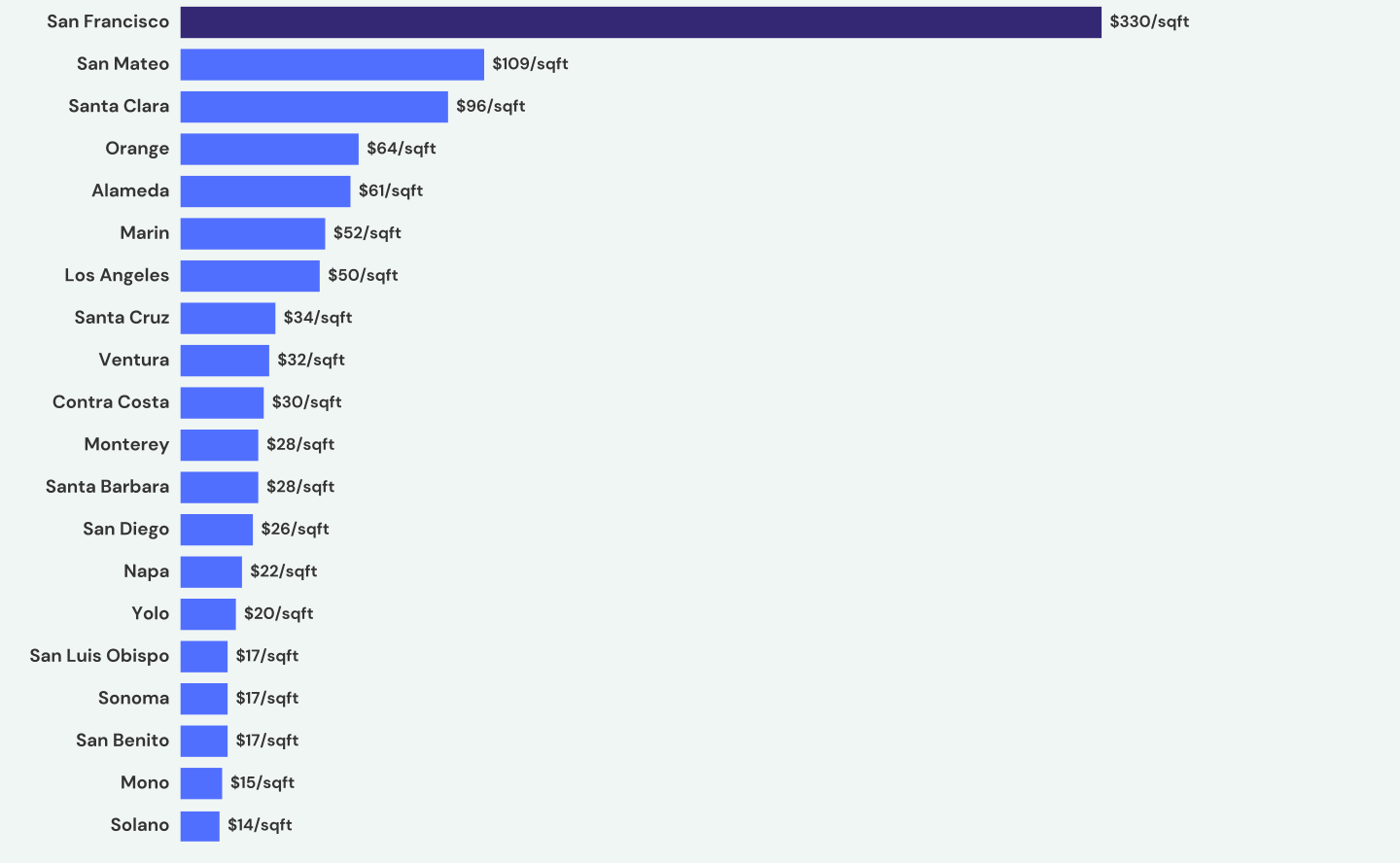
San Francisco’s residential land is worth approximately $330 per square foot, roughly three times the figure for the next-most-valuable counties (San Mateo at $109, Santa Clara at $96, Orange at $64, Alameda at $61). Most California counties sit below $20 per square foot, with rural counties dropping to a few dollars. The state’s most valuable square footage is concentrated in a small number of urban and coastal counties, and the pattern repeats within those counties, on a small number of high-value parcels.
San Francisco's land value per square foot is 3x the next county
Residential land value per square foot, top 20 California counties.
Source: CLE analysis of FHFA residential land price estimates, June 2024 release (Working Paper 19-01)
The tax burden of an LVT therefore falls heavily on this high-value urban and coastal land. The owner of a downtown San Francisco office building pays orders of magnitude more LVT per parcel than the owner of a rural Mendocino farmstead, despite both facing the same nominal rate. A uniform rate applied to a highly non-uniform distribution of land value produces a concentrated and progressive tax burden, and explains why a fractional-percent rate is sufficient to raise meaningful revenue from high-end landowners. An LVT is not designed to tax all land identically; it is designed to apply a uniform rate to a tax base whose value is concentrated where economic activity, public investment, and locational advantage are concentrated.
California land values are highly concentrated
Parcel heights represent land value per unit of land area, showing where access, amenities, infrastructure, and market demand are most concentrated.
Source: Relative distribution of land value per square foot, averaged across each PUMA (Public Use Microdata Area)
What this means for Californians
The median residential parcel in California has a market value of approximately $800,000 and a land value of approximately $425,000. A 0.25% LVT on that median parcel would cost approximately $850 per year, or under $3 per day, paid entirely by the landowner; the renter pays nothing.
The renter’s tax cost is zero because, as discussed earlier, the LVT is fully incident on the landowner. Rents do not adjust because the supply of land is fixed and every other landlord faces the same cost simultaneously.
Beyond the direct tax math, an LVT also pressures owners of underused urban land to put it to productive use. A downtown vacant lot owner currently pays a fraction of what their neighbors pay even though their parcel contributes little to the surrounding economy; under an LVT they would pay the same per-parcel rate as the apartment-building owner next door. Revenue completely aside, applying such a holding cost to idle valuable land would be one of the most direct policy levers California could use for accelerating housing development without relying on subsidies.
What this means for California’s budget
The BWT’s $20 billion target is a particular figure designed to plug a particular federal-funding hole, but it is not the only relevant target to consider. California’s full Health & Human Services budget is approximately $87 billion per year. A 0.86% LVT on the time-trended estimate of $10.12 trillion, or 1.07% on the lower estimate of $8.14 trillion, would raise the entire HHS budget indefinitely with no risk of capital flight, structurally solving the next state budget crisis (and the one after that).
A better play
A land value tax requires political will, but so does a billionaire wealth tax. Both face entrenched opposition from concentrated wealth-holders, both require legislative or constitutional action, and both ask Californians to confront a tax base that has been treated as untouchable. Both would require the expenditure of significant political capital to enact.
What separates them is everything else.
A land value tax is administratively pragmatic. It runs on California’s existing assessor infrastructure, and the work needed to update Prop 13-depressed market valuations is well-understood and with plenty of precedent in other states. A wealth tax requires building a new administrative apparatus to value private equity, founder shares, and other illiquid holdings, then defending each of four highly controversial provisions against years of litigation funded by highly motivated plaintiffs with limitless resources.
A land value tax is fiscally durable. It applies to a tax base that is roughly eight times larger than the BWT’s, grows with the California economy rather than fleeing it, and cannot be evaded by departure. The BWT has already eroded by nearly half before it has even been enacted.
A land value tax has positive economic side effects. It encourages productive use of vacant urban land, captures the public-investment windfalls that funded California’s growth, and is fully incident on landowners rather than renters. The BWT’s primary effect, beyond raising contested revenue, is incentivizing wealthy Californians to relocate and to pull their investments out of the state.
California risks losing more capital and more time on a short-term measure that is not guaranteed to succeed. A land value tax is a much better play.
Read or share the full report
The complete report, with all figures and methodology, is available as a PDF download.
Support our research
The Center for Land Economics is a 501(c)(3) nonprofit. Research like this is supported by donors like you. Donations help fund the next report.
Donate